During the pandemic, something quietly transformative happened in the legal system.
Court became visible.
Not just high-profile trials—the everyday work. Arraignments. Probation violations. Landlord–tenant cases. The mundane, procedural moments that make up the majority of court life.
If you’ve spent time watching livestream court, you may have noticed what I did:
No one knows what’s going on.
Judges spend much of their time explaining the same things—over and over.
Defendants want to tell their story, even when it isn’t time.
Attorneys, judges, and clerks rely on in-group language that prioritizes efficiency over accessibility.
And all of this makes sense.
Court is a system designed to protect due process, not to educate in real time. Everyone has a role. Everyone is expected to know their job. And there are unwritten rules layered on top of formal procedure that only become visible once you’ve been watching for a while.
This matters for interpreters because there is very little incidental learning in court.
Much of what shapes a case happens outside the courtroom.
Much of what happens inside is fast, coded, and assumption-heavy.
And much of what people want to say isn’t actually relevant—yet.
As interpreters, we’re positioned in the middle of all of this complexity.
We’re not here to explain.
We’re not here to smooth over confusion.
We’re here to render meaning accurately—while recognizing when the conditions for accuracy are compromised.
That requires more than language fluency.
It requires:
- Observational skill
- Understanding of process
- Awareness of courtroom culture
- Ethical restraint
It also requires humility.
I’ve been in courtrooms where I didn’t understand the flow until the very end. Where attorneys “raced” for the judge’s attention. Where represented cases moved first, and pro se litigants waited for a lull. None of this was written anywhere.
And yet—it shaped everything.
This is the work interpreters do quietly, constantly:
Watching. Inferring. Adjusting. Holding uncertainty without filling it in prematurely.
We don’t talk about this enough.
So much interpreter training focuses on what to do—but not enough on how to see.
That’s why I’m committed to creating spaces where interpreters can slow court down. Where we can talk openly about confusion, bias, in-group language, and the ethical lines we navigate every day.
Because court is messy.
And good interpreting doesn’t pretend otherwise.
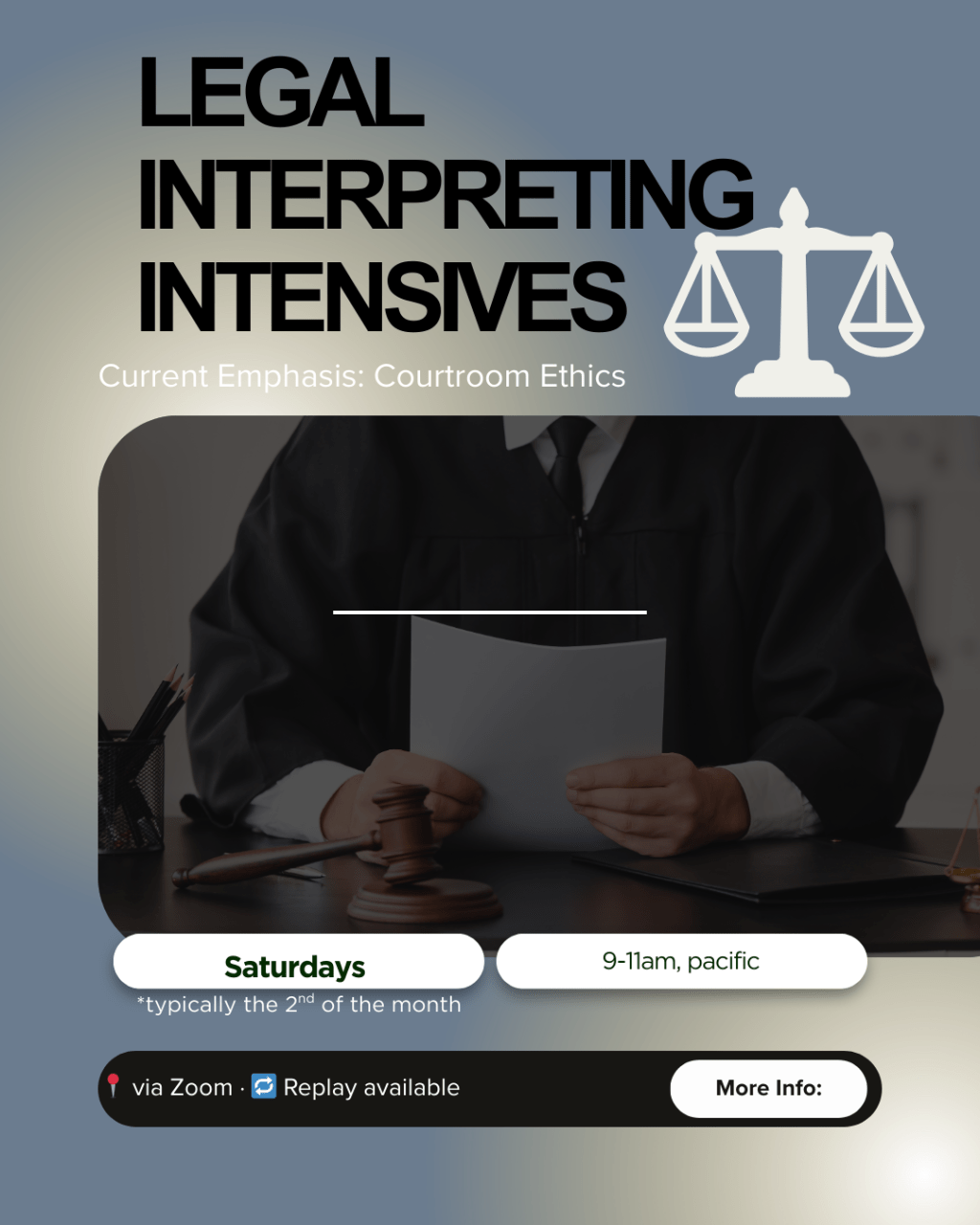
This is the spirit behind the Saturday Skills Intensives—monthly, focused gatherings where we unpack one moment at a time and practice ethical decision-making together.
 A. R. Smith Studios
Leave a comment